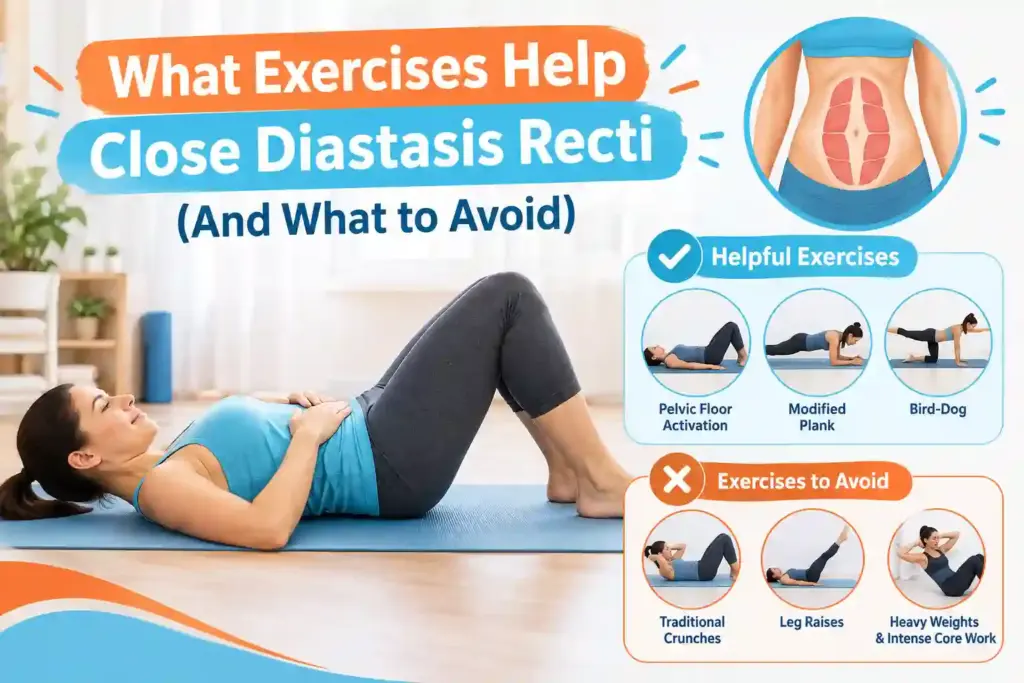
Diastasis recti can be frustrating, particularly when your stomach still looks or feels different after pregnancy despite exercising and eating well. You may notice a gap along the middle of your abdomen, a ridge or “doming” when you sit up, or simply feel that your core is not working as it used to.
The good news is that appropriate exercise can form part of recovery. However, there is no single exercise that can guarantee the abdominal muscles will “close”, and the size of the gap is not the only consideration. Strength, abdominal control, symptoms and how you move are also important.
Exercise can be a useful part of managing diastasis recti, but there is no single exercise programme that has been shown to work for everyone. Some research suggests that structured exercise may help reduce the distance between the abdominal muscles, while a 2026 systematic review found no significant reduction from exercises specifically focused on the transversus abdominis. Exercise may still help improve abdominal strength, core control and confidence with movement, although its effect on the size of the gap remains uncertain. [1][2]
What is diastasis recti?
Diastasis recti is a separation between the two sides of your abdominal muscles. It happens when the linea alba, the band of tissue running down the middle of your stomach, becomes stretched and the muscles move further apart.
It is particularly common during and after pregnancy because the abdominal wall stretches as the baby grows. The degree of separation varies between individuals, and some improvement normally occurs naturally after birth. [3]
Importantly, having a gap does not automatically mean that something is seriously wrong. Some people have a noticeable separation without significant symptoms, while others may experience reduced abdominal strength, discomfort or difficulty returning to certain activities. Also Read: Can Men Get Diastasis Recti Too?
If you have persistent symptoms, a pelvic health physiotherapist can assess your abdominal wall and help you choose appropriate exercises.
Which exercises may help diastasis recti?
Before you begin, think about how you are feeling, your current level of fitness and where you are in your recovery. If you have recently given birth or had abdominal surgery, speak with a suitably qualified healthcare professional about when it is appropriate to start exercising and which movements are right for you.
Start with gentle movements and build up gradually as you become more comfortable. If an exercise causes pain, noticeable abdominal bulging, pelvic pressure or makes your symptoms worse, stop the exercise or try a gentler variation.
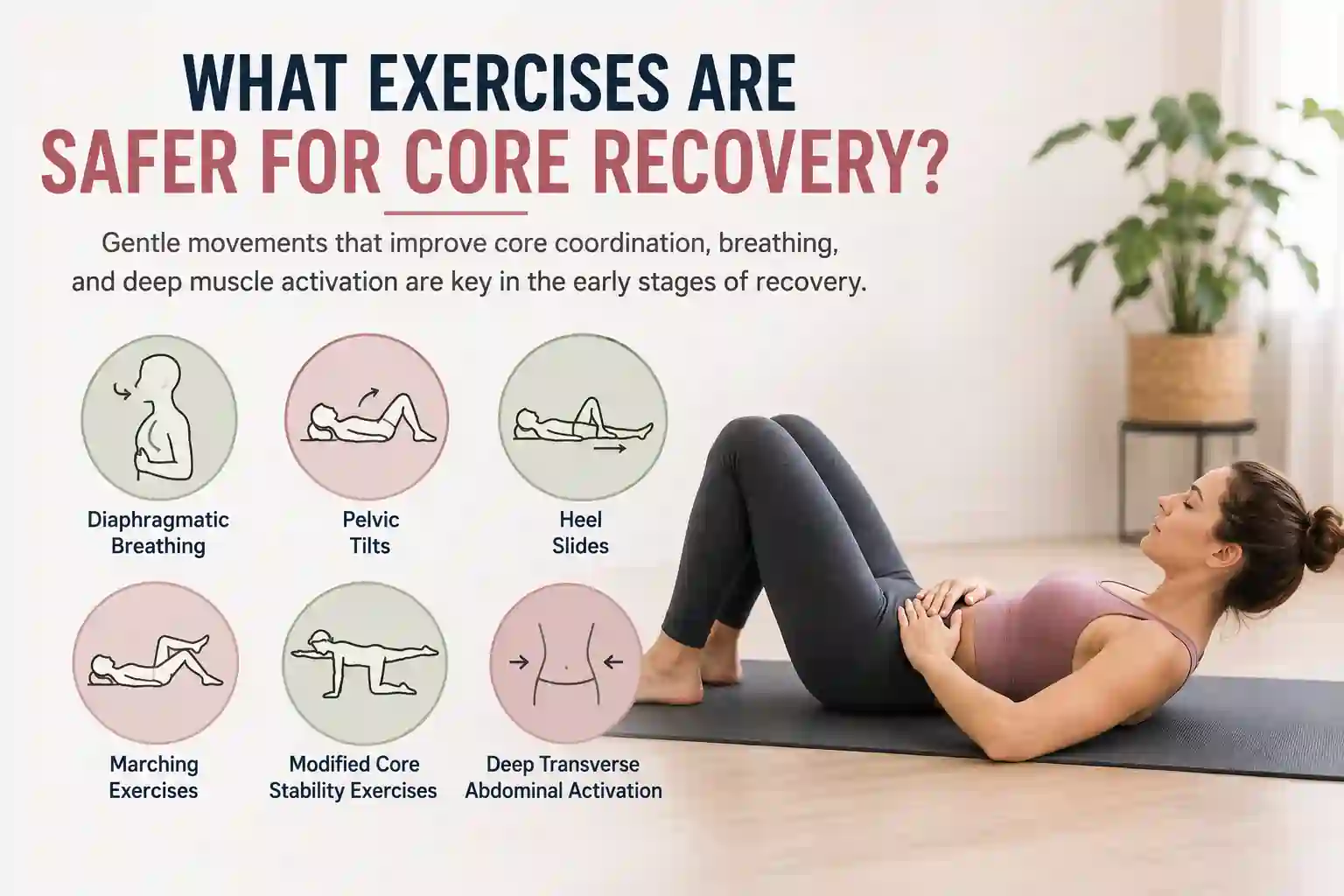
1. Gentle deep abdominal activation
Lie on your back with your knees bent and both feet resting flat on the floor. Breathe out slowly and gently pull your lower tummy in. Keep the movement light — you shouldn’t need to hold your breath or tense your whole stomach.
Keep the movement subtle. Avoid holding your breath or pulling your stomach in as tightly as possible. The goal is to practise controlled abdominal engagement rather than creating tension.
This simple exercise can be incorporated into some postnatal rehabilitation programmes. [4]
2. Pelvic floor exercises
The pelvic floor works as part of your wider core system. Pelvic floor exercises can therefore be included alongside abdominal strengthening, particularly after pregnancy.
Gently contract the pelvic-floor muscles as though you are trying to prevent passing wind or stop urine from flowing. Breathe normally, then fully relax the muscles between contractions. Avoid repeatedly stopping the flow of urine as a way of practising.
Pelvic floor training has stronger evidence for some postnatal problems, including urinary incontinence, than it does for actually reducing diastasis recti itself. [2] So it is useful to distinguish improving pelvic floor function from physically closing an abdominal gap.
3. Bridges
A bridge is a relatively simple way to strengthen the hips and trunk.
Lie on your back with your knees bent and feet comfortably positioned. Gently engage your abdominal muscles, squeeze your buttocks and lift your hips in a controlled movement.
Do not force the movement or hold your breath. If you notice significant abdominal bulging, pain or loss of control, reduce the difficulty.
NHS physiotherapy guidance includes bridges among exercises that can be used as part of abdominal and core rehabilitation. [4]
4. Bird-dog exercises
Get onto your hands and knees and find a comfortable position. Keep your movements slow and gently switch on your abdominal muscles.
If you’re new to the exercise, try lifting one arm or one leg at a time. Once that feels comfortable and controlled, you can gradually work towards lifting the opposite arm and leg together.
There is no need to stretch as far as you can. Good control matters more. If your stomach starts to bulge noticeably or you feel discomfort, make the movement smaller or return to the easier version.
5. Gradual functional strengthening
Once basic movements feel comfortable, rehabilitation can progress towards exercises that resemble everyday activities.
This may include controlled sit-to-stand movements, squats, modified resistance exercises and other movements appropriate to your individual ability.
A physiotherapist can help determine when and how to progress.
What exercises should you avoid with diastasis recti?
There is a common belief that anyone with diastasis recti Staffordshire must permanently avoid sit-ups, crunches, planks or weights. That is too simplistic.
The more useful question is whether a particular movement can currently be performed with good control and without causing symptoms.
Some people may need to temporarily modify exercises that create pronounced abdominal bulging, pain, excessive pressure or difficulty maintaining pelvic floor control.
For example, you may need to modify or temporarily avoid:
- traditional sit-ups or crunches if they cause obvious doming or discomfort
- heavy lifting that you cannot control comfortably
- high-impact exercise when your body is not ready for it after childbirth
- movements that involve repeated straining or breath-holding
- exercises that worsen urinary or bowel leakage
- advanced core exercises that are currently beyond your level of control
NHS pelvic health guidance specifically advises seeking professional advice where there is a significant abdominal gap, visible bulging, ongoing pain or associated pelvic health symptoms. [5]
This does not mean that these exercises are forbidden forever. Rehabilitation is usually about appropriate progression rather than avoiding movement indefinitely. Also check out: Combining Treatments for Faster Post-Pregnancy Recovery
Can More Exercise Make Diastasis Recti Heal Faster?
Research into exercise-based management of diastasis recti has produced mixed findings. Some studies report a reduction in the distance between the abdominal muscles following structured exercise, while others have found no significant improvement with particular approaches.
Exercise may still help improve abdominal strength, coordination and core control. However, no single exercise programme has been proven to achieve complete closure in everyone.
This is why the aim should not be to exercise your stomach until it feels exhausted. Instead, focus on gradually improving strength, coordination and control.
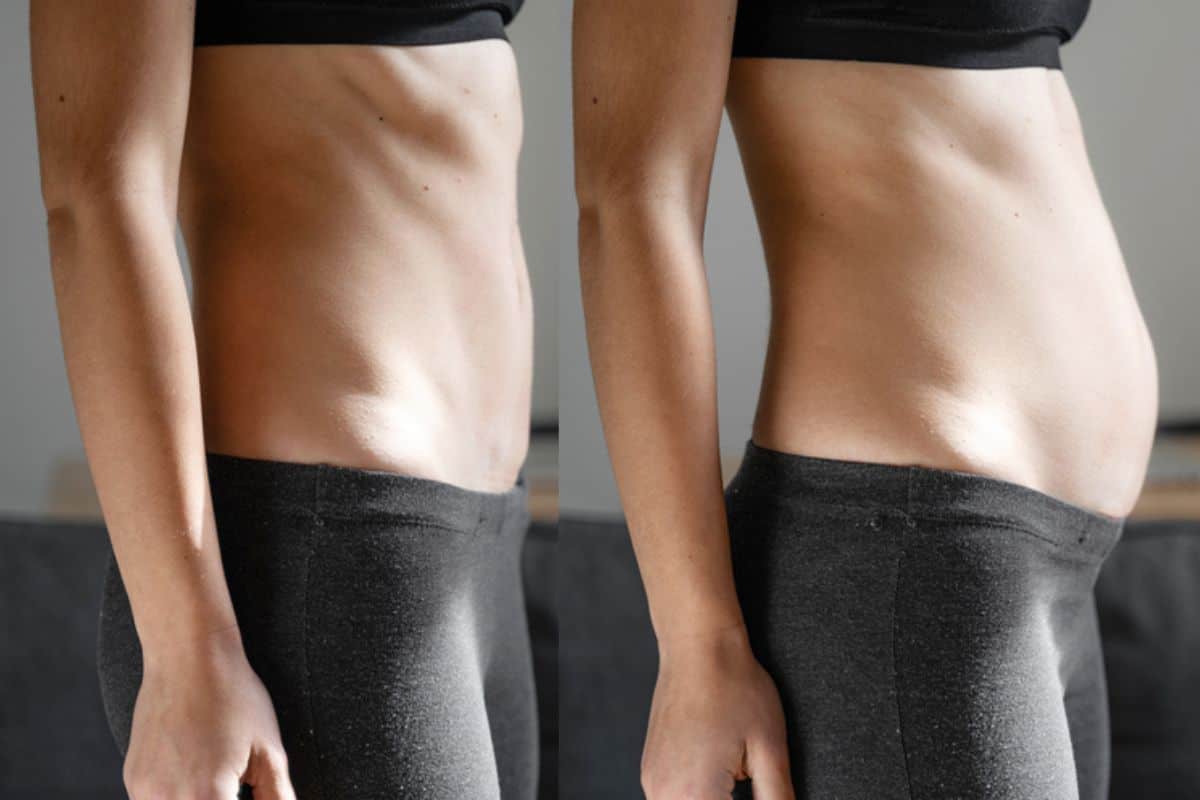
Your progress may also be better judged by how comfortably you move, how well you manage everyday activities and whether your core feels stronger, rather than by the width of the gap alone.
How long does diastasis recti take to improve?
There is no set recovery time for diastasis recti, as everyone’s recovery is different.
After pregnancy, the separation between the abdominal muscles often becomes smaller during the early months after birth. However, the amount of improvement can vary from person to person. [3]
Your recovery can be influenced by factors including your pregnancy and birth, previous abdominal strength, symptoms, activity levels and the type and progression of exercise you undertake.
If the separation remains noticeable or you are experiencing symptoms, this does not mean that you have done anything wrong. It may simply be appropriate to have an individual assessment.
When should you see a physiotherapist or GP?
Exercise is not a substitute for medical assessment when there may be another underlying problem.
Consider speaking to your GP or a pelvic health physiotherapist if you have:
- persistent or significant abdominal pain
- a pronounced or persistent abdominal bulge
- urinary or bowel leakage
- pelvic pressure or heaviness
- significant back or pelvic pain
- difficulty returning to normal activities
- concerns about a possible abdominal hernia
- symptoms that are getting worse rather than improving
NHS pelvic health physiotherapy services specifically provide assessment and rehabilitation for diastasis recti Staffordshire and related pelvic health problems. [6]
If you have recently given birth, your return to exercise should also take account of your delivery, recovery and any complications. High-impact or strenuous activity may need to be introduced gradually rather than immediately. [7]
Can exercise completely close diastasis recti?
It is important to be realistic.
Exercise may improve abdominal strength and control and may reduce the measured separation in some people. However, it cannot guarantee complete anatomical closure.
The appearance of your abdomen can also be influenced by skin, body composition, posture and the underlying abdominal wall. Reducing a gap between the muscles is therefore not necessarily the same as achieving a completely flat stomach.
If your main concern is the appearance of your abdomen rather than pain or functional problems, discuss your expectations carefully with an appropriately qualified professional before considering any cosmetic treatment.

What about EMS Body Sculpting for diastasis recti?
EMS Body Sculpting is a non-surgical body-contouring treatment that may be considered for some people who are concerned about the appearance or muscle tone of their abdomen.
It is important to distinguish this type of cosmetic treatment from assessment and rehabilitation for diastasis recti. EMS Body Sculpting should not be presented as a guaranteed way to close an abdominal separation, repair the linea alba or replace pelvic health physiotherapy.
If you have pain, significant abdominal bulging, pelvic-floor symptoms or concerns about your abdominal separation, seek an assessment from an appropriately qualified healthcare professional. If your main concern is the appearance of your abdomen, discuss your expectations and whether a cosmetic treatment is appropriate for you before proceeding.
Results can vary between individuals, and no cosmetic treatment should be presented as guaranteeing complete closure of diastasis recti.
The most important thing: progress gradually
Improving diastasis recti Staffordshire is a gradual process, so doing more or exercising harder will not necessarily lead to quicker results. Start with movements that feel comfortable and that you can control properly, then gradually increase the challenge as your strength develops. If an exercise causes pain, visible bulging, leakage or a feeling of increased pressure, stop and seek appropriate professional advice.
Most importantly, do not judge your recovery solely by the width of the abdominal gap.
A stronger, better-controlled core and a comfortable return to everyday activities can be meaningful improvements even when some separation remains. Check More: RF Microneedling for Wrinkles, Fine Lines and Skin Laxity: What to Know
For personalised advice, particularly if you have ongoing symptoms following pregnancy or abdominal surgery, a pelvic health physiotherapist is the appropriate professional to assess your individual needs.
Frequently Asked Questions
Q: Can walking help with diastasis recti Staffordshire?
Walking is a useful low-impact activity for general fitness and gradual return to activity after childbirth. It is not, by itself, a specific treatment that guarantees closure of diastasis recti Staffordshire. Your activity should be increased gradually according to your recovery and symptoms. [7]
Q: Are planks bad for diastasis recti?
Not automatically. A plank may be inappropriate at a particular stage if you cannot control your abdominal wall or it causes pain, pronounced doming or other symptoms. A modified version may be more suitable before progressing to a full plank.
Q: Should I stop doing crunches if I have diastasis recti Staffordshire?
If crunches consistently cause pronounced abdominal doming, discomfort or loss of control, they should be modified or temporarily avoided. However, there is not enough evidence to say that every person with diastasis recti must permanently avoid abdominal flexion exercises. [1][4]
Q: Should I have treatment for diastasis recti?
Not everyone with diastasis recti needs treatment. If you have symptoms or difficulty returning to normal activities, assessment by a healthcare professional or pelvic health physiotherapist can help identify appropriate management. Cosmetic concerns should be discussed separately from symptoms that require medical assessment.
Q: Can diastasis recti cause back pain?
Diastasis recti Staffordshire may occur alongside lower back or pelvic discomfort, particularly when abdominal strength and core control have changed. However, abdominal separation is not necessarily the cause of back pain. If your pain is persistent, severe or affecting everyday activities, it is worth speaking with a GP or qualified physiotherapist to identify the underlying cause.
Q: Can I lift weights with diastasis recti Staffordshire?
In many cases, resistance training can eventually form part of a gradual return to exercise. The appropriate weight and exercises depend on your strength, symptoms, recovery stage and ability to control the movement. If lifting causes pain, pronounced abdominal bulging, leakage or excessive straining, seek professional guidance.
Q: Is diastasis recti only caused by pregnancy?
No. Pregnancy is a common reason for abdominal separation, but diastasis recti Staffordshire can also occur in other circumstances involving stretching or increased pressure on the abdominal wall. An assessment is useful if you are unsure whether what you are noticing is diastasis recti or another condition.
Q: How do I know whether my abdominal gap is normal?
The size of a gap alone does not tell the whole story. Symptoms, abdominal tension, function and how the abdominal wall behaves during movement are also relevant. If you are concerned about a persistent gap or visible bulging, seek an individual assessment rather than relying solely on a self-measurement.
REFERENCES & FURTHER READING
[1] Lyons G, Nogueira R, Wagemaker Viana S, et al. (2026)
What is the evidence for abdominal and pelvic floor muscle training to treat diastasis recti abdominis postpartum? An updated systematic review and meta-analysis. Hernia. PubMed record. Relevant to the evidence surrounding exercise-based management of postpartum diastasis recti.
[2] Beamish NF, Davenport MH, Ali MU, et al. (2025)
Impact of postpartum exercise on pelvic floor disorders and diastasis recti abdominis: a systematic review and meta-analysis. British Journal of Sports Medicine. PubMed record. Provides evidence on postpartum exercise and its potential effects on diastasis recti and pelvic floor outcomes.
[3] NHS
Your post-pregnancy body – Separated stomach muscles. NHS guidance. Used for general information about abdominal separation following pregnancy and expected recovery.
[4] Frimley Health NHS Foundation Trust
Pelvic Health – Core and Diastasis Recti Abdominis Exercises. Frimley Health NHS guidance. Provides practical examples of core and abdominal exercises used in rehabilitation.
[5] University Hospitals of North Midlands NHS Trust
Postnatal – Diastasis Rectus Abdominis. UHNM postnatal guidance. Supports information about abdominal separation, symptoms and when professional assessment may be appropriate.
[6] Leeds Teaching Hospitals NHS Trust
Postnatal Physiotherapy. Leeds Teaching Hospitals guidance. Supports the role of pelvic health physiotherapy following pregnancy.
[7] NHS
Keeping fit and healthy with a baby – Exercising after having a baby. NHS exercise guidance. Supports guidance on gradually returning to physical activity after having a baby.
For Further Information, Please Call Us ON 03300 100 238